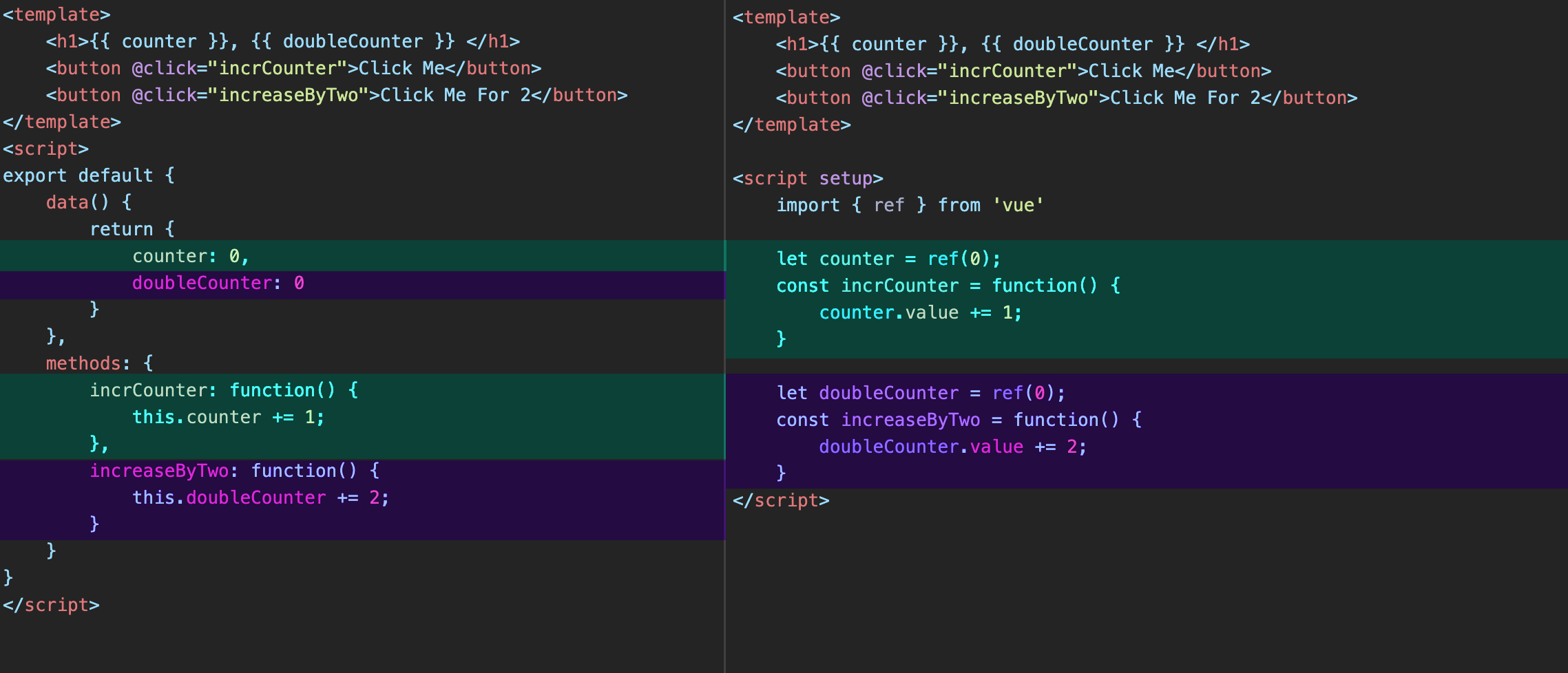
The difference is small, but you might notice something interesting - on the Composition API, all the related code stays close together, so you don’t have to hope around as much. In the image below, you can see that, where code with similar functionality is highlighted in the same colour.
On the right, the Composition API keeps its code all in the same place. On small projects, this doesn’t make a big difference - but on larger ones, maintainability increases.

Other Benefits to the Composition API
- Replaces mixins, and all the issues such as name collisions that come along with them.
- Better type support, since it uses mostly normal functions and variables, no complicated typing is required in TypeScript.
- Smaller files - as mentioned, the Composition API requires less code.
Do I need to use the Composition API now?
No! There is no reason to switch your code to the Composition API if the Options API still works fine for you. The Options API isn’t going anywhere, and instead the Composition API provides an alternative means to create Vue components.
In some cases, the Options API may still be a better option for you (pun not intended).
Is the Composition API better than the Options API?
There is no simple answer to that question. Both methods have their merits, and they may be useful in certain situations. Whatever you decide to go with is totally fine, but the Composition API does solve some of the issues the Options API brought along with it.